
MBBS college · Department planning
Forensic Medicine
These are the items commonly listed for the Forensic Medicine department. Tick the ones you need in your list and add your own quantities.
- 90items listed
- 10groups
- 61named in official documents
- 1scale with MBBS seats
90 items in 10 groups below. Tap a group to open it; tap “About this item” to read more. Lists are for planning; please follow current official norms.
What the regulations say
61 of 90 items on this page are named in NMC Form-B 2024, NMC UG-MSR 2023. 1 have a figure that depends on MBBS seats.
| Item | Source | 50 seats | 100 seats | 150 seats |
|---|---|---|---|---|
| Autopsy table 2 per autopsy block | NMC UG-MSR 2023 | 2 | 2 | 2 |
Figures come from NMC and government documents dated up to February 2026. Many are minimums. Items marked in grey are government benchmarks (for example IPHS 2022), not binding on private colleges. Check the current official norms before ordering.
Autopsy block
8 items
Autopsy table NMC UG-MSR 2023About this item
What it is: An autopsy table is a stainless steel table on which a body is placed for post-mortem examination. It usually has drainage and a water supply for washing.
How it is used: In forensic medicine it is the main workspace for post-mortem examinations, including those observed by students for teaching.
Used in: Forensic Medicine
Options: Buyers choose between fixed and height-adjustable tables, and between tables with or without downdraft air extraction.
Portable X-ray machine in autopsy block (shareable with Radiology) NMC UG-MSR 2023About this item
What it is: A movable X-ray machine on wheels that can be taken to a patient's bedside, so X-ray images can be taken where the patient is.
How it is used: Used in the autopsy block to X-ray bodies for fractures, bullets and foreign objects before or during post-mortem examination.
Used in: Forensic Medicine
Options: Buyers choose between analogue, CR and digital models.
Computers with printers NMC UG-MSR 2023About this item
What it is: Desktop computers with attached printers.
How it is used: Used in departments such as anatomy and forensic medicine for records, reports, teaching material and office work.
Used in: Anatomy, Forensic Medicine
Options: Buyers choose between laser and inkjet printers.
Post-mortem report software NMC UG-MSR 2023About this item
What it is: Computer software used to prepare, store and print post-mortem examination reports. It provides standard report formats and keeps records searchable for later reference.
How it is used: Forensic medicine departments use it to record autopsy findings in a consistent format, maintain case records, and retrieve past reports for medico-legal work and teaching.
Used in: Forensic Medicine
Options: Buyers usually choose between standalone desktop software and networked or web-based systems that link with hospital records.
Air conditioning for mortuary block NMC UG-MSR 2023About this item
What it is: Air conditioning system for the mortuary building, including the autopsy room and associated areas. It controls temperature and helps with air circulation.
How it is used: Keeps the mortuary block cool and more comfortable for staff, students and visitors, and supports odour control alongside exhaust ventilation.
Used in: Forensic Medicine
Options: Options include split units, ducted central systems and package units, depending on building size.
Dead body freezer NMC UG-MSR 2023About this item
What it is: A freezer unit designed to hold bodies at below-freezing temperatures for longer storage than a standard cooler allows.
How it is used: Used in the forensic medicine department to preserve bodies that must be stored for an extended period, such as unidentified cases.
Used in: Forensic Medicine
Options: Buyers choose by number of bodies held and between chest-type and cabinet-type designs.
Protective clothing and equipment for autopsy staff NMC UG-MSR 2023About this item
What it is: A group of protective items for autopsy staff. It typically includes gowns, aprons, gloves, masks, face shields, caps and boots.
How it is used: In forensic medicine it protects doctors, staff and students from infection and splashes during post-mortem examinations.
Used in: Forensic Medicine
Options: Buyers choose between disposable and reusable items and between standard and higher-protection masks and gowns.
- Video-conferencing room for court evidence (internet, computer, video camera) NMC UG-MSR 2023
Poison information centre / analytical toxicology (if functional)
5 items
Digital spectrophotometer NMC UG-MSR 2023About this item
What it is: A digital spectrophotometer is an instrument that measures how much light a sample absorbs at selected wavelengths and shows the result digitally.
How it is used: In forensic medicine it is used to help identify and measure substances in samples, such as in toxicology work.
Used in: Forensic Medicine
Options: Buyers choose between visible-only and UV-visible models.
Chemical balance NMC UG-MSR 2023About this item
What it is: A laboratory balance used to weigh chemicals and small samples. Traditional models are two-pan beam balances used with a set of standard weights; newer models are electronic.
How it is used: Used to weigh chemicals and samples when preparing reagents and solutions, and for weighing specimens during practical work and routine laboratory procedures.
Used in: Blood Centre, Forensic Medicine
Options: Buyers choose between a traditional two-pan beam balance with weights and an electronic single-pan balance.
Distillation plant NMC UG-MSR 2023About this item
What it is: A unit that boils water and condenses the steam to produce distilled water, which is free of most dissolved salts and impurities.
How it is used: Used to supply pure water for preparing reagents and solutions and for rinsing glassware in laboratory testing and analysis.
Used in: Forensic Medicine
Options: Buyers choose by output capacity, glass or stainless steel construction, and single or double distillation.
Spectroscopic lens with adjustable slit NMC UG-MSR 2023About this item
What it is: An optical instrument with a lens and adjustable slit that splits light into its colours, showing the light absorption pattern of a sample.
How it is used: Used in forensic medicine to examine samples such as blood for characteristic absorption bands, and to teach this method to students.
Used in: Forensic Medicine
Options: Variants differ between hand-held and bench-mounted models.
TLC, HPLC, GC-MS NMC UG-MSR 2023About this item
What it is: A group of chemical analysis methods: thin-layer chromatography (TLC), high-performance liquid chromatography (HPLC) and gas chromatography-mass spectrometry (GC-MS). Each separates and identifies substances in a sample.
How it is used: Used in forensic toxicology laboratories to screen for and confirm drugs and poisons, with simpler methods for screening and advanced ones for confirmation.
Used in: Forensic Medicine
Options: Buyers may choose individual systems or a combined toxicology laboratory setup.
Department items
9 items
Anthropometric set (7 ft folding rod, osteometric board, craniometer, mandibulometer, goniometer, vernier calipers, height equipment, dial weighing machine) NMC UG-MSR 2023About this item
What it is: An anthropometric set is a collection of measuring instruments for the human body and skeleton. This set lists a folding rod, osteometric board, craniometer, mandibulometer for the jaw, goniometer for angles, vernier calipers, height equipment and a dial weighing machine.
How it is used: In forensic medicine it is used to measure bodies, skulls and bones for identification and to teach students forensic anthropology.
Used in: Forensic Medicine
Options: Buyers choose between manual and digital measuring tools and between individual items and a complete set.
Digital pH meter NMC UG-MSR 2023About this item
What it is: An electronic instrument with a probe that measures how acidic or alkaline a liquid is, shown as a pH number on a digital display.
How it is used: Used to check the pH of solutions, reagents and samples, for example when preparing buffers or testing body fluids and chemical samples.
Used in: Forensic Medicine, Pharmacology
Options: Buyers choose between pocket, portable and bench-top models, and by accuracy and automatic temperature compensation.
Refrigerator NMC UG-MSR 2023About this item
What it is: A refrigerator is an insulated, electrically cooled cabinet that keeps its contents cold but above freezing point.
How it is used: In clinical areas and laboratories it is used to store medicines, reagents, samples and other items that need to be kept cool.
Used in: Forensic Medicine, ICU and HDU, Reproductive Medicine
Options: Buyers choose capacity, single- or double-door design, and domestic or laboratory-grade models.
Centrifuge NMC UG-MSR 2023About this item
What it is: A centrifuge is a machine that spins tubes of liquid at high speed so that heavier parts, such as blood cells or sediment, settle to the bottom.
How it is used: Used to separate serum or plasma from blood, and to concentrate urine and other samples, before testing or examination under the microscope.
Used in: Clinical Haematology, Forensic Medicine, Microbiology
Options: Buyers choose by number and size of tubes, maximum speed, analog or digital controls, and fixed-angle or swing-out rotor.
Slide warming table NMC UG-MSR 2023About this item
What it is: A flat electric warming surface that holds many glass slides at a gentle, even temperature for drying or spreading sections.
How it is used: In forensic medicine labs it is used to dry and prepare tissue and smear slides from autopsy samples for microscope study and teaching.
Used in: Forensic Medicine
Options: Buyers choose by surface size and between fixed or adjustable temperature controls.
Hot plate NMC UG-MSR 2023About this item
What it is: A flat electrically heated plate used to warm or heat containers placed on top of it, with a control knob to adjust heat.
How it is used: Used to heat solutions and chemicals, and to warm or dry slides when preparing samples for microscope examination.
Used in: Clinical Haematology, Forensic Medicine, Pathology
Options: Buyers choose by plate size and material, temperature control, and models with a built-in magnetic stirrer.
Dissection set, complete NMC UG-MSR 2023About this item
What it is: A full set of hand instruments for dissection, typically including scalpels, forceps, scissors, probes, retractors and similar tools in a case or tray.
How it is used: Used in forensic medicine for post-mortem examination and teaching, giving the examiner all basic dissecting tools in one set.
Used in: Forensic Medicine
Options: Sets differ in the number and type of instruments included and the storage case provided.
Digital BP instrument NMC UG-MSR 2023About this item
What it is: An automatic blood pressure monitor with an electronically inflated cuff and a digital reading display.
How it is used: Used in forensic medicine for routine clinical examination of living persons brought for medico-legal assessment.
Used in: Forensic Medicine
Options: Buyers choose between upper-arm and wrist models.
Stethoscope NMC UG-MSR 2023About this item
What it is: A listening instrument with a chest piece, tubing and earpieces, used to hear sounds from the heart, lungs and abdomen.
How it is used: Used in clinical examination across departments to listen to heart, lung and bowel sounds, and taught to students from physiology practicals onwards.
Used in: Blood Centre, Community Medicine, Forensic Medicine, OPD — common items, Physiology
Options: Buyers choose between single-head and dual-head types, and adult, paediatric or electronic models.
Medico-legal work
17 items
Cold storage for dead bodies NMC UG-MSR 2023About this item
What it is: A refrigerated storage unit with compartments that keeps bodies at low temperature. It may be a cabinet-style unit or a cold room.
How it is used: Used in the forensic medicine department to keep bodies preserved before post-mortem examination and until release.
Used in: Forensic Medicine
Options: Buyers choose by body capacity, cabinet versus walk-in design, and type of cooling system.
Weighing machine for dead bodies NMC UG-MSR 2023About this item
What it is: A weighing scale built to weigh a whole body, often with a large platform or a tray that fits a trolley or stretcher.
How it is used: Used in the mortuary to record body weight as part of the post-mortem examination record.
Used in: Forensic Medicine
Options: Buyers choose between platform scales, hanging scales and trolley-mounted scales, in digital or mechanical form.
Autopsy tables NMC UG-MSR 2023About this item
What it is: An autopsy table is a stainless steel table on which a body is placed for post-mortem examination. It usually has drainage and a water supply for washing. Departments often need more than one table.
How it is used: In forensic medicine and mortuaries they are used for post-mortem examinations and for teaching students autopsy procedures.
Used in: Forensic Medicine
Options: Buyers choose between pedestal and wall-mounted tables, and between models with or without ventilation features.
Stryker-type autopsy saw with accessories NMC UG-MSR 2023About this item
What it is: An electric oscillating saw whose blade moves back and forth rapidly rather than spinning. It cuts bone while limiting damage to soft tissue. Accessories include spare blades and keys.
How it is used: Used during autopsy to cut bone, such as opening the skull, in a controlled way. Students see it used during post-mortem demonstrations.
Used in: Forensic Medicine
Options: Buyers choose between models with or without dust or vacuum attachments, and different blade shapes and sizes.
Weighing machine for organs NMC UG-MSR 2023About this item
What it is: A weighing scale with a removable pan or bowl for weighing individual internal organs. It is usually digital and easy to clean.
How it is used: Used during autopsy to record the weight of organs such as the heart, liver and brain, which forms part of the post-mortem report.
Used in: Forensic Medicine
Options: Buyers choose between digital and dial-type scales, and between different pan sizes and capacities.
Weighing machine for fetus NMC UG-MSR 2023About this item
What it is: A small, sensitive weighing scale with a tray suitable for weighing a fetus or newborn. It is usually digital for accurate readings of small weights.
How it is used: Used in forensic medicine to record weight during examination of fetal remains, which helps in estimating age of the fetus.
Used in: Forensic Medicine
Options: Variants differ in tray shape, weighing capacity and digital or mechanical display.
Brain knife NMC UG-MSR 2023About this item
What it is: A long, thin, flat-bladed knife designed to slice the brain cleanly into even, parallel sections.
How it is used: In anatomy and forensic medicine it is used to cut brain specimens during dissection and autopsy to study its internal structure.
Used in: Anatomy, Forensic Medicine
Options: Buyers choose by blade length and between fixed-blade and replaceable-blade designs.
Hack saw NMC UG-MSR 2023About this item
What it is: A hand saw with a fine-toothed blade stretched across a frame. It cuts through hard materials such as bone.
How it is used: In forensic medicine it is used during autopsies to cut bones, such as the skull or ribs, when a powered saw is not used.
Used in: Forensic Medicine
Options: Buyers choose by frame type and blade length, and between standard and fine-toothed blades.
Rib shears, left and right NMC UG-MSR 2023About this item
What it is: Heavy, strong cutting shears with angled blades made for cutting through ribs. They are supplied as a pair, one angled for each side of the chest.
How it is used: Used during autopsy to open the chest wall so that internal organs can be examined. Students observe their use during post-mortem demonstrations.
Used in: Forensic Medicine
Options: Variants differ in length, blade angle and whether they are made of stainless steel or plated steel.
Measuring tape (steel roll) NMC UG-MSR 2023About this item
What it is: A roll-up measuring tape with a steel blade, which does not stretch, in a protective case.
How it is used: Used in forensic medicine to measure body length, injuries and distances accurately during examination and for recording in reports.
Used in: Forensic Medicine
Options: Buyers choose by tape length and case type.
Magnifying lens NMC UG-MSR 2023About this item
What it is: A handheld magnifying lens that makes small objects and details look larger, allowing close examination without a microscope.
How it is used: Forensic Medicine uses it to examine items such as wounds, injuries, hair, fibres, bullets and documents in more detail.
Used in: Forensic Medicine
Options: Buyers choose between plain and illuminated lenses and different sizes.
X-ray view box (4-in-1) NMC UG-MSR 2023About this item
What it is: A four-in-one X-ray view box is a lit viewing panel wide enough to display four X-ray films side by side.
How it is used: Used in forensic medicine to view several X-ray films of a case together, for example for age estimation and injury assessment, during teaching and medico-legal work.
Used in: Forensic Medicine
Options: Main choices are LED or fluorescent lighting and wall-mounted or table-top design.
Tooth extractors, left and right NMC UG-MSR 2023About this item
What it is: Dental forceps designed to grip and remove teeth. They are supplied in pairs shaped for the left and right sides of the jaw.
How it is used: In forensic medicine they are used to remove teeth for examination, such as for age estimation or identification, and in teaching dental aspects of forensic work.
Used in: Forensic Medicine
Options: Sets vary by the number of forceps included and their shapes for upper and lower teeth.
Hand-set heat sealer NMC UG-MSR 2023About this item
What it is: A hand-operated device that seals plastic bags or covers by pressing them with a heated bar.
How it is used: Used in forensic medicine to seal sample and evidence packets so that they are closed securely before storage or dispatch to a laboratory.
Used in: Forensic Medicine
Options: Buyers choose by seal length and between hand-press and impulse-type sealers.
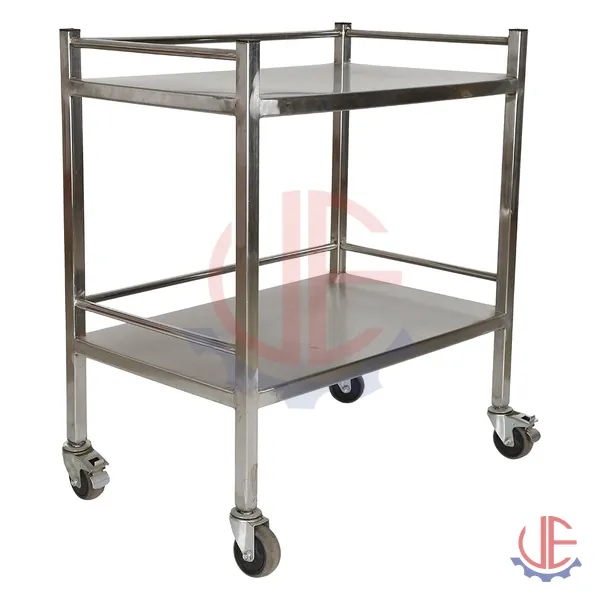 Instrument trolley NMC UG-MSR 2023About this item
What it is: An instrument trolley is a wheeled cart, usually stainless steel, with one or more flat shelves for laying out instruments.
How it is used: It holds instruments and supplies close to the work area during procedures, deliveries, ICU care and autopsies, and is moved between areas as needed.
Used in: Forensic Medicine, ICU and HDU, Labour room
Options: Buyers choose the size, number of shelves, and with or without a railing or drawer.
Rectal thermometer NMC UG-MSR 2023About this item
What it is: A thermometer with a long probe designed to measure internal body temperature. It may be a glass type or a digital type with a probe.
How it is used: In forensic medicine it is used to record body temperature during post-mortem examination, which helps in estimating the time since death and is demonstrated to students.
Used in: Forensic Medicine
Options: Common choices are digital probe thermometers and traditional long-stem chemical thermometers.
Portable X-ray machine (shareable with Radiology) NMC UG-MSR 2023About this item
What it is: A movable X-ray machine on wheels that can be taken to a patient's bedside, so X-ray images can be taken where the patient is.
How it is used: Used in forensic medicine to X-ray bodies and examine injured persons, often shared with the radiology department.
Used in: Forensic Medicine
Options: Buyers choose between analogue, CR and digital models.
Equipment
22 items
Autopsy dissection table with running water NMC Form-B 2024About this item
What it is: A post-mortem table, usually stainless steel, with a built-in water supply and drainage so the surface can be rinsed during and after examination.
How it is used: Used in the forensic medicine department for post-mortem examinations, keeping the work area clean during the procedure.
Used in: Forensic Medicine
Options: Variants differ in fixed or movable design, sink placement and water and drainage fittings.
Autopsy examination instrument set NMC Form-B 2024About this item
What it is: A post-mortem instrument set is a collection of tools for autopsy. It typically includes knives, scissors, forceps, saws, a chisel, a hammer, probes, a skull key and measuring tools.
How it is used: In forensic medicine it is used to carry out post-mortem examinations and to teach students autopsy procedure.
Used in: Forensic Medicine
Options: Buyers choose between basic and comprehensive sets, and between stainless steel grades and case types.
Oscillating bone saw NMC Form-B 2024About this item
What it is: An electric saw whose blade moves rapidly back and forth instead of rotating. It cuts bone while limiting damage to soft tissue.
How it is used: In forensic medicine it is used during autopsies to open the skull and cut other bones quickly and neatly.
Used in: Forensic Medicine
Options: Buyers choose between corded and battery models, and between models with or without dust or vacuum extraction.
Student microscopes NMC Form-B 2024About this item
What it is: Simple, sturdy light microscopes made for routine use by students in practical classes, with standard magnifying lenses and built-in lighting.
How it is used: Biochemistry and Forensic Medicine students use them to examine samples such as urine deposits, crystals, hair and fibres on slides.
Used in: Biochemistry, Forensic Medicine
Options: Buyers choose between monocular and binocular models, and LED or halogen lighting.
Binocular microscope with display and photography NMC Form-B 2024About this item
What it is: A binocular light microscope fitted with a camera and connected to a screen, so the image can be shown and photographed.
How it is used: Forensic Medicine uses it to examine samples such as hair, fibres or tissue and to record images, and to show them to a group of students at once.
Used in: Forensic Medicine
Options: Buyers choose between a built-in or add-on camera, and a separate monitor or a computer-based display.
Mortuary X-ray machine NMC Form-B 2024About this item
What it is: An X-ray machine placed in or near the mortuary, used for taking X-ray images of bodies before or during autopsy.
How it is used: Used in forensic medicine to find fractures, bullets or foreign objects and to support age estimation and identification.
Used in: Forensic Medicine
Options: Buyers choose between fixed and portable units and analogue or digital imaging.
Ultrasonography NMC Form-B 2024About this item
What it is: A machine that uses high-frequency sound waves to create live images of internal organs and tissues without X-rays.
How it is used: Used in forensic medicine to support examinations, such as estimating age-related features or assessing injuries, alongside other methods.
Used in: Forensic Medicine
Options: Buyers usually choose between portable and cart-based machines.
Dead body weighing machine NMC Form-B 2024About this item
What it is: A weighing machine designed to weigh a whole dead body, often built into a trolley, stretcher or platform.
How it is used: In forensic medicine it is used to record body weight as part of post-mortem examination and identification.
Used in: Forensic Medicine
Options: Buyers choose between mechanical and digital models, and between platform, trolley and hanging designs.
HPLC NMC Form-B 2024About this item
What it is: HPLC (high-performance liquid chromatography) is a laboratory instrument that separates, identifies and measures the parts of a liquid mixture.
How it is used: It is used in biochemistry, pathology and forensic labs for tests such as haemoglobin variants, HbA1c, drug levels and poisons.
Used in: Biochemistry, Forensic Medicine, Pathology
Options: Buyers choose between general-purpose and dedicated systems and the type of detector.
Gas chromatography NMC Form-B 2024About this item
What it is: A laboratory instrument that separates a mixture into its individual chemical parts by passing it through a heated column with a carrier gas.
How it is used: Used in forensic toxicology to detect and identify substances such as alcohol, drugs and poisons in samples, and in teaching analytical methods.
Used in: Forensic Medicine
Options: Buyers choose by detector type, column options and whether an automatic sample loader is included.
GC-MS NMC Form-B 2024About this item
What it is: Gas chromatography-mass spectrometry: an instrument that first separates a chemical mixture and then identifies each part by its molecular mass.
How it is used: Used in forensic toxicology to identify drugs, poisons and other substances in samples with a high level of certainty.
Used in: Forensic Medicine
Options: Options vary by mass spectrometer type, sample loader and software libraries.
Anthropometric set NMC Form-B 2024About this item
What it is: An anthropometric set is a collection of measuring instruments for the human body and skeleton. It typically includes rods, calipers, a craniometer for the skull, an osteometric board for long bones, and height and weight instruments.
How it is used: In forensic medicine it is used to measure bodies and bones, helping estimate age, sex and height in identification work and teaching.
Used in: Forensic Medicine
Options: Buyers choose between basic manual sets and sets with digital calipers and scales.
Deep freezer NMC Form-B 2024About this item
What it is: A deep freezer is a freezer that keeps items at temperatures well below the freezing point of water.
How it is used: It is used in laboratories and forensic medicine to store samples, reagents and other materials that must be kept frozen.
Used in: Clinical Haematology, Forensic Medicine
Options: Buyers choose between chest and upright models and the lowest temperature range needed.
Body cold storage NMC Form-B 2024About this item
What it is: A refrigerated unit or room with separate compartments for keeping bodies at low temperature. It slows natural changes until examination or handover.
How it is used: Used in the forensic medicine department and mortuary to store bodies awaiting post-mortem examination or release to families.
Used in: Forensic Medicine
Options: Buyers choose by number of bodies held, front- or side-loading cabinets, and modular units versus walk-in rooms.
SLR camera NMC Form-B 2024About this item
What it is: A single-lens reflex camera with interchangeable lenses.
How it is used: Used in forensic medicine to take clear photos of injuries, bodies and evidence for records and teaching.
Used in: Forensic Medicine
Options: Buyers choose between digital models and lens kits.
Video camera NMC Form-B 2024About this item
What it is: A camera for recording moving images and sound.
How it is used: Used in forensic medicine to record autopsies, examinations and demonstrations for teaching and records.
Used in: Forensic Medicine
Television NMC Form-B 2024About this item
What it is: A television set for showing video content.
How it is used: Used in forensic medicine and other departments to show teaching videos and recorded material.
Used in: Forensic Medicine
Options: Buyers choose by screen size and type.
Projectors NMC Form-B 2024About this item
What it is: Multimedia projectors that display computer or video content on a screen or wall.
How it is used: Used in forensic medicine and other departments for lectures, case discussions and demonstrations.
Used in: Forensic Medicine
Options: Buyers choose by brightness, resolution and portable or ceiling-mounted fitting.
Baby weighing machine NMC Form-B 2024About this item
What it is: A scale designed to weigh infants and small children, with a tray or cradle that holds the baby safely.
How it is used: Used in community medicine for growth monitoring and nutrition studies, and in forensic medicine where infant weight must be recorded.
Used in: Community Medicine, Forensic Medicine
Options: Buyers choose between mechanical spring scales and digital electronic scales.
Organ weighing machine NMC Form-B 2024About this item
What it is: An organ weighing machine is a scale with a tray or pan used to weigh individual organs, such as the heart, liver or brain.
How it is used: In forensic medicine it is used during autopsy to record organ weights, which can show disease or injury.
Used in: Forensic Medicine
Options: Buyers choose between mechanical dial scales and digital scales.
Shadowless OT light in PM room NMC Form-B 2024About this item
What it is: A ceiling- or wall-mounted examination light that gives bright, even lighting with very little shadow. It is the same type of light used in operation theatres.
How it is used: Installed above the autopsy table so that doctors and students can see fine details clearly during post-mortem examinations and demonstrations.
Used in: Forensic Medicine
Options: Buyers choose between ceiling-mounted and mobile stand models, single or twin domes, and LED or halogen lighting.
- Sexual-offence examination room with UV lamp NMC Form-B 2024
Furniture — department office
9 items
Executive table for Head of Department About this item
What it is: A larger office desk for a department head, usually with drawers and a side unit for files.
How it is used: Used in the Head of Department's office for administrative work, meeting faculty and students, and managing department records.
Used in: Anaesthesiology, Anatomy, Biochemistry, Community Medicine, Dentistry, Dermatology, ENT, Forensic Medicine and more
Options: Choices include wooden or laminate finishes, with or without side return, and lockable pedestal drawers.
Revolving office chair About this item
What it is: An office chair that swivels on a base with wheels, usually with height adjustment and a cushioned seat and back.
How it is used: Used by faculty and office staff across departments at desks and computer tables for daily paperwork, computer work and record keeping.
Used in: Anaesthesiology, Anatomy, Biochemistry, Community Medicine, Dentistry, Dermatology, ENT, Forensic Medicine and more
Options: Options include mesh or cushioned backs, with or without armrests, medium or high back, and fabric or leatherette covers.
Visitor chairs About this item
What it is: A fixed-leg chair placed in front of a desk for guests, usually with a cushioned seat and sometimes armrests.
How it is used: Placed in front of office and department desks, where visitors, students, patients' relatives or colleagues sit during meetings.
Used in: Administration, Anaesthesiology, Anatomy, Biochemistry, Community Medicine, Dentistry, Dermatology, ENT and more
Options: Options include steel or wooden frames, cushioned or plain seats, with or without armrests, and fabric or leatherette covers.
Office table About this item
What it is: A standard working desk for office use, usually with one or more drawers.
How it is used: Used by faculty and office staff in departments for paperwork, record keeping and meeting students or colleagues.
Used in: Anaesthesiology, Anatomy, Biochemistry, Community Medicine, Dentistry, Dermatology, ENT, Forensic Medicine and more
Options: Options include steel, wooden or laminate construction, with or without lockable drawers, and different sizes.
Computer table About this item
What it is: A desk designed for a computer, usually with space for the monitor and often a sliding keyboard tray and CPU shelf.
How it is used: Used in department offices, the library and computer areas for staff and students to work on computers, records and online resources.
Used in: Anaesthesiology, Anatomy, Biochemistry, Central Library, Community Medicine, Dentistry, Dermatology, ENT and more
Options: Options include wooden, laminate or steel construction, with or without keyboard tray, CPU stand and drawers.
Steel almirah About this item
What it is: A tall steel cupboard with lockable doors and internal shelves for safe storage.
How it is used: Used across offices and departments to store files, records, stationery, teaching materials and other items that need to be kept locked.
Used in: Administration, Anaesthesiology, Anatomy, Biochemistry, Community Medicine, Dentistry, Dermatology, ENT and more
Options: Options include different heights, full or half shelves, with or without a locker compartment, and plain or glass-panel doors.
Filing cabinet About this item
What it is: A cabinet with deep pull-out drawers for keeping files and documents upright and organised, usually made of steel.
How it is used: Used in administrative and department offices to store student records, staff files, correspondence and other official documents.
Used in: Administration, Anaesthesiology, Anatomy, Biochemistry, Community Medicine, Dentistry, Dermatology, ENT and more
Options: Buyers choose between two-, three- or four-drawer models, with or without central lock, and steel or wooden construction.
Bookshelf / book rack About this item
What it is: A shelf unit for storing books, journals and files in an upright, easy-to-see arrangement.
How it is used: Used in department offices, seminar rooms and departmental libraries to keep reference books, journals, theses and records.
Used in: Anaesthesiology, Anatomy, Biochemistry, Community Medicine, Dentistry, Dermatology, ENT, Forensic Medicine and more
Options: Options include steel or wooden construction, open shelves or glass doors, with or without lock, and adjustable shelves.
Side rack About this item
What it is: A small rack or low cabinet placed beside a desk to hold files, books and frequently used items.
How it is used: Used next to desks in department offices and faculty rooms to keep working files, books and stationery within easy reach.
Used in: Anaesthesiology, Anatomy, Biochemistry, Community Medicine, Dentistry, Dermatology, ENT, Forensic Medicine and more
Options: Options include steel or wooden construction, open shelves or with doors, and with or without lock.
Furniture — faculty rooms
5 items
Office table About this item
What it is: A standard working desk for office use, usually with one or more drawers.
How it is used: Used by faculty and office staff in departments for paperwork, record keeping and meeting students or colleagues.
Used in: Anaesthesiology, Anatomy, Biochemistry, Community Medicine, Dentistry, Dermatology, ENT, Forensic Medicine and more
Options: Options include steel, wooden or laminate construction, with or without lockable drawers, and different sizes.
Revolving office chair About this item
What it is: An office chair that swivels on a base with wheels, usually with height adjustment and a cushioned seat and back.
How it is used: Used by faculty and office staff across departments at desks and computer tables for daily paperwork, computer work and record keeping.
Used in: Anaesthesiology, Anatomy, Biochemistry, Community Medicine, Dentistry, Dermatology, ENT, Forensic Medicine and more
Options: Options include mesh or cushioned backs, with or without armrests, medium or high back, and fabric or leatherette covers.
Visitor chairs About this item
What it is: A fixed-leg chair placed in front of a desk for guests, usually with a cushioned seat and sometimes armrests.
How it is used: Placed in front of office and department desks, where visitors, students, patients' relatives or colleagues sit during meetings.
Used in: Administration, Anaesthesiology, Anatomy, Biochemistry, Community Medicine, Dentistry, Dermatology, ENT and more
Options: Options include steel or wooden frames, cushioned or plain seats, with or without armrests, and fabric or leatherette covers.
Steel almirah About this item
What it is: A tall steel cupboard with lockable doors and internal shelves for safe storage.
How it is used: Used across offices and departments to store files, records, stationery, teaching materials and other items that need to be kept locked.
Used in: Administration, Anaesthesiology, Anatomy, Biochemistry, Community Medicine, Dentistry, Dermatology, ENT and more
Options: Options include different heights, full or half shelves, with or without a locker compartment, and plain or glass-panel doors.
Bookshelf / book rack About this item
What it is: A shelf unit for storing books, journals and files in an upright, easy-to-see arrangement.
How it is used: Used in department offices, seminar rooms and departmental libraries to keep reference books, journals, theses and records.
Used in: Anaesthesiology, Anatomy, Biochemistry, Community Medicine, Dentistry, Dermatology, ENT, Forensic Medicine and more
Options: Options include steel or wooden construction, open shelves or glass doors, with or without lock, and adjustable shelves.
Furniture — laboratory
7 items
Laboratory work bench with reagent shelf About this item
What it is: A laboratory work bench with a raised shelf along its length for keeping reagent bottles (chemicals used in tests) within reach.
How it is used: Students use it during practical classes, with the reagents they need placed on the shelf above their work area.
Used in: Anatomy, Biochemistry, Forensic Medicine, Microbiology, Pathology, Pharmacology, Physiology
Options: Options include single-sided or double-sided benches, different worktop materials, and with or without storage below.
Laboratory work bench with sink About this item
What it is: A laboratory work bench with a built-in sink and tap for washing hands, glassware and equipment.
How it is used: Students and staff use it in practical labs where water is needed for staining slides, rinsing glassware and cleaning up after experiments.
Used in: Anatomy, Biochemistry, Forensic Medicine, Microbiology, Pathology, Pharmacology, Physiology
Options: Buyers choose between steel and ceramic or polymer sinks, single or double sinks, and different bench lengths and worktops.
Laboratory stool, height adjustable About this item
What it is: A backless or low-back seat for laboratory use whose seat height can be raised or lowered.
How it is used: Students and staff use it at lab benches so they can sit at a comfortable height while using microscopes or doing bench work.
Used in: Anatomy, Biochemistry, Forensic Medicine, Microbiology, Pathology, Pharmacology, Physiology
Options: Common choices are gas-lift or screw height adjustment, with or without wheels, and with or without a backrest.
Demonstrator's table and chair About this item
What it is: A table and matching chair for the teacher or demonstrator who supervises practical classes in a laboratory.
How it is used: The demonstrator uses it to keep teaching material, record attendance and practical work, and show items to students during lab sessions.
Used in: Anatomy, Biochemistry, Forensic Medicine, Microbiology, Pathology, Pharmacology, Physiology
Options: Buyers choose between wooden and steel frames, tables with or without drawers, and fixed or revolving chairs.
Wall-mounted storage cabinet About this item
What it is: A cabinet fixed to the wall, with doors and shelves, which saves floor space.
How it is used: Fitted in practical labs and demonstration rooms to store glassware, reagents, specimens, slides and small items above the work area.
Used in: Anatomy, Biochemistry, Forensic Medicine, Microbiology, Pathology, Pharmacology, Physiology
Options: Buyers choose between steel, wooden or laminate construction, glass or solid doors, and with or without lock.
Instrument cupboard About this item
What it is: A lockable cupboard with shelves for storing laboratory instruments, glassware and small equipment when not in use.
How it is used: Pre-clinical and para-clinical labs use it to store dissection sets, glassware and small devices safely between practical classes.
Used in: Anatomy, Biochemistry, Forensic Medicine, Microbiology, Pathology, Pharmacology, Physiology
Options: Options include steel or wooden construction, glass-panel or solid doors, and different heights and shelf counts.
Chemical / reagent storage cabinet About this item
What it is: A closed cabinet for storing chemicals and reagents (substances used in lab tests). It usually has shelves, lockable doors and a body that resists spills and corrosion.
How it is used: Departments such as Biochemistry, Pathology and Pharmacology use it to keep stains, solutions and other chemicals organised, labelled and away from students' work areas.
Used in: Anatomy, Biochemistry, Forensic Medicine, Microbiology, Pathology, Pharmacology, Physiology
Options: Buyers choose between steel and wooden bodies, single or double doors, and plain or ventilated designs for chemicals that give off fumes.
Furniture — teaching room
4 items
Student chair with writing pad About this item
What it is: A chair with a small attached writing surface on one arm, so a student can sit and write without a separate desk.
How it is used: Used in demonstration rooms, tutorial rooms and seminar halls, where students sit to attend small-group classes and take notes.
Used in: Anatomy, Biochemistry, Community Medicine, Dermatology, ENT, Forensic Medicine, General Medicine, General Surgery and more
Options: Options include steel or plastic frames, right- or left-hand writing pads, cushioned or plain seats, and with or without a storage tray.
Teacher's table and chair About this item
What it is: A desk with a matching chair for a teacher, usually with a drawer for notes, attendance registers and stationery.
How it is used: Placed at the front of demonstration rooms and practical labs, where the teacher sits to take attendance, prepare and conduct classes.
Used in: Anatomy, Biochemistry, Community Medicine, Dermatology, ENT, Forensic Medicine, General Medicine, General Surgery and more
Options: Buyers choose between steel, wooden or laminate desks, with or without lockable drawers, and fixed or revolving chairs.
Podium / lectern About this item
What it is: A stand with a sloping top for a teacher to rest notes while speaking, sometimes with a shelf below.
How it is used: Used in demonstration rooms and seminar rooms, where teachers stand to take classes, give presentations and conduct discussions.
Used in: Anatomy, Biochemistry, Community Medicine, Dermatology, ENT, Forensic Medicine, General Medicine, General Surgery and more
Options: Options include wooden or laminate finish, fixed or movable, and with or without a microphone mount.
White board / display board About this item
What it is: A wall board with either a white dry-erase writing surface or a pin-up display surface. Some models combine both on one board.
How it is used: Used in demonstration rooms, seminar rooms and department corridors for teaching, notices, timetables, charts and display of student work.
Used in: Anatomy, Biochemistry, Community Medicine, Dermatology, ENT, Forensic Medicine, General Medicine, General Surgery and more
Options: Common choices include white writing surface, soft pin-up board or combination board, magnetic surface, and wall-mounted or movable stand.
Furniture — museum
4 items
Specimen display cabinet with glass doors About this item
What it is: A display cabinet with glass doors and shelves designed to hold specimen jars, models and other museum exhibits.
How it is used: Department museums use it to show preserved specimens and teaching models so students can view and study them while they remain safe and dust-free.
Used in: Anatomy, Community Medicine, Forensic Medicine, Microbiology, Pathology, Pharmacology
Options: Common variants are wall-mounted or free-standing, wooden or aluminium frames, and different widths and shelf numbers.
Specimen racks / shelves About this item
What it is: Open racks or shelving units for holding specimen jars, models and other teaching items in rows.
How it is used: Department museums and store rooms use them to arrange large numbers of specimens in an orderly, labelled way for viewing and storage.
Used in: Anatomy, Community Medicine, Forensic Medicine, Microbiology, Pathology, Pharmacology
Options: Buyers choose between steel and wooden shelving, wall-fixed or free-standing units, and stepped (tiered) or flat shelves.
Glass showcase About this item
What it is: A cabinet with glass panels on the front and sides so that the items inside can be seen without opening it.
How it is used: It is used in department museums to display specimens, models and charts so students can study them while the items stay protected from dust and handling.
Used in: Anatomy, Community Medicine, Forensic Medicine, Microbiology, Pathology, Pharmacology
Options: Common choices are wall-mounted or free-standing units, wooden or aluminium frames, and the number of shelves.
Museum seating benches / chairs About this item
What it is: Benches or chairs placed in a department museum so visitors can sit while viewing exhibits.
How it is used: Students sit on them while studying specimens, models and charts in the museum during self-study or teaching sessions.
Used in: Anatomy, Community Medicine, Forensic Medicine, Microbiology, Pathology, Pharmacology
Options: Common choices are benches or individual chairs, steel or wooden frames, and with or without backrests.
How Unnat Exports helps with Forensic Medicine
- One list, one quotation
Every item for Forensic Medicine, from equipment to furniture, quoted together, item-wise, with GST shown.
- Matched to the documents
Item names follow the wording used in NMC and government planning documents, so your list reads the way inspectors expect.
- Help with specifications
Not sure which model or size? Our team goes through the options with you before quoting.
- Supply across India
Delivery and installation for your city are confirmed in the quotation.
Before you finalise your Forensic Medicine list
- Check your MBBS intake and any PG seats; several quantities scale with them.
- Compare the list with the current official norms for your college. The table above shows which items the documents name.
- Measure the rooms, labs or wards so furniture and equipment fit.
- Decide which items you already have and which need replacing.
- Note any tender or department specifications you must follow.
Send this checklist with your list and we will quote against it.
Common questions
What does Unnat Exports supply for the Forensic Medicine department?
Items from the autopsy block, poison information centre / analytical toxicology (if functional), department items, medico-legal work groups on this page, plus furniture for the department office, faculty rooms, laboratory. Most of them fall under mortuary, autopsy & forensic equipment, office, classroom, library & hostel furniture, laboratory & museum furniture.
Do I have to buy everything on this list?
No. The list shows items commonly bought for this department. You choose the items and quantities you need; every quantity box starts empty.
Do you also supply furniture for the Forensic Medicine department?
Yes. This page lists furniture for the department office, faculty rooms, laboratory, teaching room, museum. Tell us your room sizes in the note box if you need custom sizes.
Is this the official list of requirements?
No. It is a planning list to help you prepare your purchase. Please check the current official norms that apply to your college, such as the National Medical Commission documents, before you finalise quantities.
How do I get a quotation for Forensic Medicine?
Open the list builder, tick the items, type your quantities and send the list. You can also send the list you already have on WhatsApp at 94674 67836.
Can you help me choose models and specifications?
Yes. When you send your list, tick “I need help choosing specifications” and our team will call you to go through the options before quoting.
Ready to get a quotation?
Tick what you need, type your quantities, and send the list to Unnat Exports. Or just message us on WhatsApp.